Important Copyright Notice
The material presented in Market-Based Management is available in print, or online, and is for authorized use by only the purchaser of this material. Market-Based Management is a copyright product with all rights reserved.
No part of this material may be reproduced, stored, or transmitted in any form or by any means – electronic, mechanical, photocopying, recording, or otherwise. Unauthorized use is prohibited and is a violation of the rights of authors and copyright holders. Civil and criminal penalties may be imposed for copyright infringement.
Market-Based Management is for your private use only.
Customer Value
MBM Handbook
"The most important single thing is to focus obsessively on the customer," according to Jeff Bezos, the CEO and architect of Amazon. To excel, business-school students, executives, and managers must learn to create, measure and manage customer value. This is the central focus of most successful companies today. Recognizing this, many business schools seek to offer a focused course teaching students about customer value from a marketing, strategy, and finance perspective.
The MBM handbook on "Customer Focus" fulfills this need. It starts with the premise that successful companies anchor their strategy on customer value, measured as customer satisfaction. Students and managers learn that creating customer value increases financial returns by measuring different components of a customer-value map and implementing them.
MBM Handbook Overview
This MBM Handbook includes three chapters that provide a strategic overview of customer focus and take readers into the depth of "how to" accomplish the strategic task of creating, measuring and managing customer value.
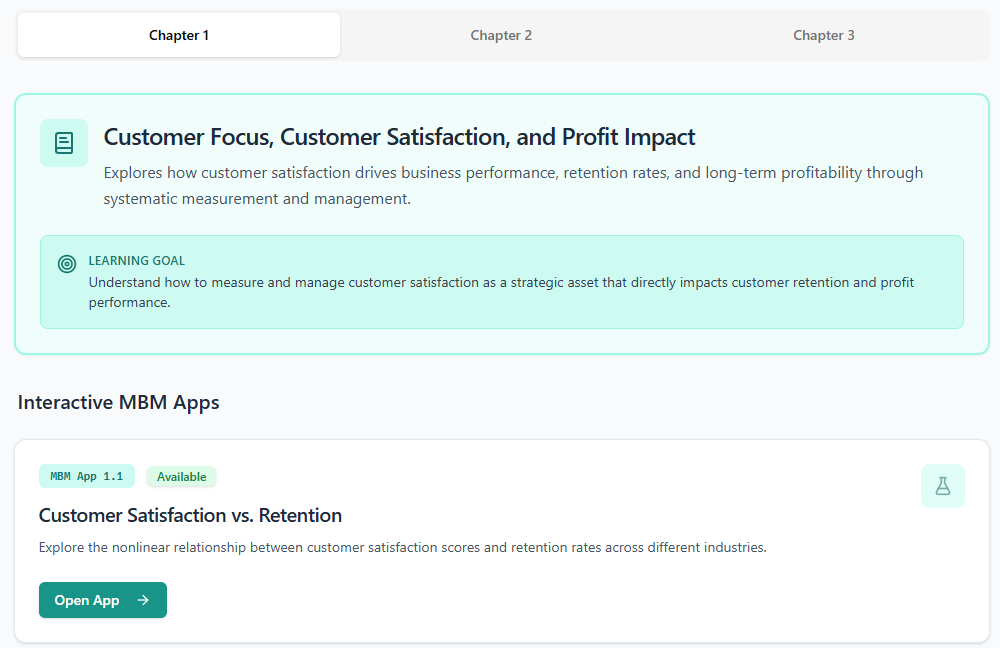
Chapter 1 shows how measuring customer value enables firms to manage customer retention, customer lifetime value, and customer loyalty.
Chapter 2 shows different qualitative-research methods to surface and understand the different drivers of customer value. This information is key to developing the customer value equation as shown in the next module.
Chapter 3 provides detailed and worked out examples of companies that used customer value strategically. It shows how companies can measure and weight the different components of customer value, create a value map, and decide on their overall strategy.
Customer Value – Handbook Features
Each chapter provides a systematic way for learning the core tenets of customer value, how it is created, measured, and managed. Key features of the handbook include:
- Incorporates the latest peer-reviewed research published in top journals
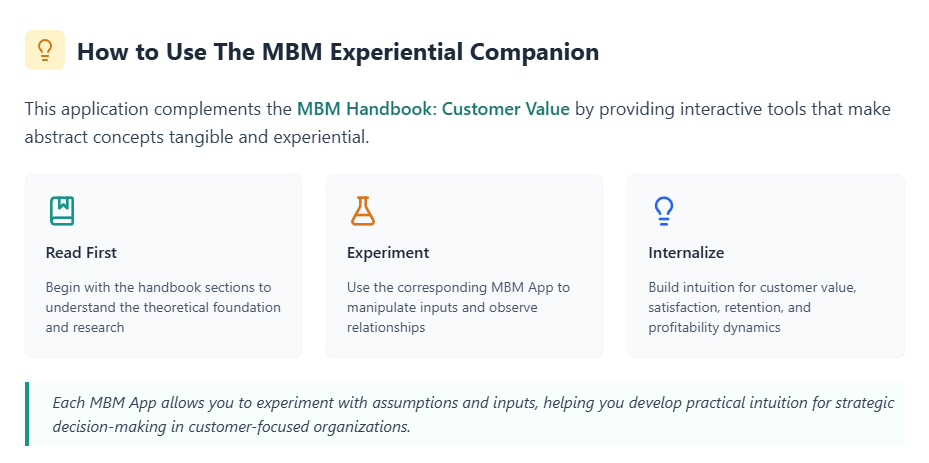
- Interactive MBM/APPS enable students to experiment with key concepts
- Mini cases and exercises to engage students – Home Depot, Peet's Coffee, HP PhotoSmart Printer, Drill Press, Almetta Snacks and FedEx
- Video-based, self-paced exercises that can be used as async assignments
- A blend of quantitative and qualitative concepts
Handbook & Course Formats: Suitable for many different courses and teaching formats.
College Courses
- Introduction to marketing
- Capstone marketing or strategy
- Online marketing course (videos, interactive apps, and async assignments)
Executive Education:
- 2-day intense course on marketing strategy
- Non-degree executive-education engagements
- Off-site, customer courses for companies
Chapter 1: Customer Focus, Customer Satisfaction, and Profit Impact
Chapter 2: Customer Experience, VOC and Value Drivers
Chapter 3: Customer Value: Create, Measure & Manage
Customer Value
"Being market-driven means that everything done by everyone in the company is driven by the needs of the target market(s) you serve."1
A market-based business has a strong customer focus that is reflected by all its functions and employees. All members of a customer-focused business are sensitive to customers' needs, are aware of competitors' moves, and work together toward a timely market-based customer solution. What's the payoff from customer focus? Customer focused businesses have higher revenue, are more profitable and have more satisfied customers, employees, and shareholders.
Chapter 1 examines the relationship between customer satisfaction and profitability. This is the core of a customer-focused organization. This chapter extends this paradigm to include customer retention, customer lifetime value and customer recommendation to others as ways of promoting customer and sales growth. A customer-focused company has a customer compass that directs its attention on a particular set of customers, not all consumers. The core elements of customer focus are presented with examples and interactive MBM/APPs to enhance the readers' understanding of the importance of customer satisfaction in managing a customer-focused company.
Chapter 2 provides a qualitative look at how companies build a strong customer focus. A customer-focused company uses the voice of the customer to understand value drivers—factors that drive customer value. This chapter presents the various methods used to gather and integrate the customer voice and customer experience. Once the value drivers have been ascertained, quantitative research can be used to rank order them for strategic insights. MBM/APPs enable readers to experience major qualitative tools used to capture the customer voice and customer experience.
Chapter 3 shows different ways to measure customer value and rank order the value drivers of customer value. To be meaningful, firms must measure and manage customer value and rank order its drivers. You can't manage what you don't measure. This chapter looks at four ways to measure and manage customer value – relative value, economic value, ownership value and lifetime value. While relative value is based on performance and price relative to benchmark competitors, the other three of these methods provide an economic measure of customer value. MBM/APPs enhance the readers' understanding of customer value metric with experimentation.
1. M. Frichol (2009), "Marketing in a 'Market-Driven' Company," The Marketing Mélange, http://marketing.infocat.com/2009/02/ marketing-in-market-driven company.html, retrieved February 12, 2009.
Experiential Learning Resources
Digital companions to support every role in your learning journey
FOR STUDENTS
Experiential Companion
Interactive apps, case studies, and exercises to deepen your understanding of customer value concepts.
FOR INSTRUCTORS
Instructor Companion
Complete teaching resources: slides, assignments, test banks, case studies, and video homework for all three chapters.